
What you need to know about credit cards

What is a credit card?

A credit card is a card from your bank that allows you to borrow money to pay for something, based on your available credit, up to your credit limit.

You have to pay back the money you borrowed, plus interest. Interest is a fee you pay for borrowing the money – you always want to look for credit card with a low interest rates.

What is a credit limit and available credit?

Your credit limit is how much you are allowed to spend. Your available credit is the difference between how much you have spent and your limit.

How is a credit card different from a debit card?

A debit card is directly connected to your checking account, so when you make purchases, you can’t spend more money than you have in your account. A credit card allows you to borrow money you do not have, which then becomes a debt you owe.

Benefits of having a credit card:

It allows you to buy something now and pay over time.

It doesn’t put your debit card or bank account info at risk.

pay

It helps you improve your credit score when you pay the bill on time and pay off your balance.

Concerns with having a credit card:

wallet

It’s really easy to buy more than you can pay back.

dollar bubble

When you owe money and are charged interest, you will end up paying more money.

going down icon

Opening too many credit cards can lower your credit score.

bhn9

What is a credit score?

A credit score is a number between 300 and 850 that helps bank, credit card, and loan companies know how reliable you are at paying them back and paying on time.
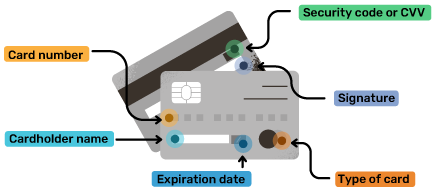
What’s on my credit card?

Card number
The number that identifies this specific card.

Cardholder name
The person who the card belongs to. This could be on either side of your card.

Expiration date
The month and year your card expires. After it expires, you will no longer be able to use the card.

Security code or CVV
The security code or card verification value (CVV) is usually a 3 or 4-digit number on the front or back of your card that is used as an extra layer of security.

Signature
Most credit cards require your signature on the line on the back of your card as an added layer of security.

Type of card
The most common type of cards are Mastercard, Visa, or American Express. This could be on either side of your card.

How do credit cards work?

Each time you try to make a purchase:
bhn - 10

You will need to swipe through, tap on, or insert the card into a card reader, or provide your credit card information online or on the phone.

bhn - 11

Your bank will either approve the purchase (if you have available credit) or decline the purchase (if you do not have enough available credit).

bhn - 12

If the purchase is approved, the available credit goes down by that amount. You will need to pay off what you owe within a certain period of time to avoid interest.

How does interest work?

When you have an unpaid balance on your credit card from one month to the next, you are charged interest on the money you owe. Interest is a fee for borrowing the money and is a percentage of your balance, added to the money you owe.

For example, let’s say your credit card balance is $300 and the interest rate on your card is 15%

Calculating your interest:

(balance × interest rate)

$300
×
.15
=
$45

Calculating your new balance:

(original balance + interest)

$300
+
$45
=
$345

Some credit cards offer a certain amount of time with no interest or 0% APR on certain purchases. In this case, you are not charged interest every month, but if you do not pay the full amount off within the period, you will be charged interest on the full amount (not just what you currently owe.)

What is APR?

APR is the Annual Percentage Rate and is the full cost of borrowing money. It includes interest, as well as other fees and costs.

How can I be credit-card smart?

Tips for using your credit card:
bhn - 13

Use payment reminders or set up autopay to help you make payments on time.

bhn - 14

Look for credit card with a low interest and APR rates.

bhn - 15

Set up balance alerts, which are texts, email, or app notifications that let you know when your balance is approaching a certain level. For example, you can set an alert to let you know when you are at 30% of your credit limit.

bhn - 16

If your payment is due at an inconvenient time, call and ask if you can switch to another day, such as just after a payday.

bhn - 17

Choose a credit card with rewards or cash back, to get the most out of your spending.

bhn - 18

If you have to carry over a balance from month to month, try to carry only 30% of your credit limit. For example, if your limit is $1000, you want to carry no more than $300 from one month another.

Learn how we helped 100 top brands gain success